Loading your experience...
Loading your experience...

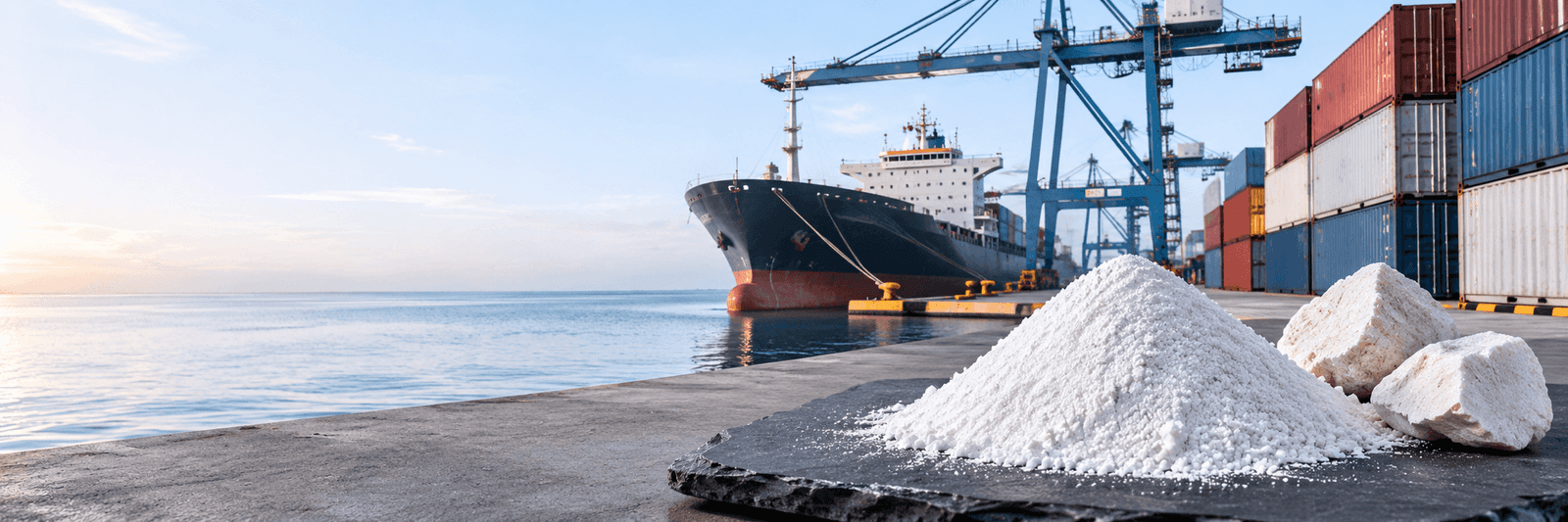
"What is the price per ton?" is the first question every barite buyer asks, and the least useful one to answer in isolation. Two quotes with the same number can mean very different things: one may be a lower density grade, the other may leave out freight and insurance, and a third may assume a different packing method. A price only means something once you know what's behind it.
This page is for buyers who are ready to compare: importers, drilling-fluid and mud service companies, oilfield materials traders, and paint, coatings and plastics manufacturers. It explains what moves a barite export price, how to compare offers on the same basis and how to request a quote from India. Namakwala is a third-generation Indian mineral and salt exporter, and barite sits alongside garnet and quartz in its minerals range.
Barite demand is led by drilling, and prices follow drilling activity, freight and import reliance. Published market reports for 2026 show a mixed but generally firm picture:
These are third-party market figures for specific markets, grades and terms. They are not Namakwala quotes, and regional levels differ because grade, freight and import costs differ. Use them only as background.
Factor = Why it changes the price
Specific gravity (density) = Namakwala barite ranges from 4.1 to 4.6 g/cm³. Drilling specifications often set a minimum, and the grade you need affects which lots qualify
Particle size and grinding = Powder is customizable, and finer or tighter-sized product takes more processing than lumps
Whiteness and purity = Matters for paint, coatings, plastics and paper, less for drilling
Form = Powder or lumps
Packaging = Bulk or bagged, and the bag type, discussed per order
Quantity = A full container or several containers prices differently from a part load
Delivery terms = EXW, FOB, CFR, CIF or DAP, which decide what's included
Freight and shipping market = Ocean rates move, and so does container availability
Documents and inspection = Certificates, and any independent inspection you require
Payment terms = Timing and method of payment
A price quoted FOB can't be compared with one quoted CIF until you add what's missing. A quick guide to the common terms:
Term = What the seller covers = What you still pay for
EXW = Goods made available at the seller's premises = Everything from there: loading, export clearance, freight, insurance, import
FOB = Delivery on board the vessel at the named port of shipment, with export clearance = Main sea freight, insurance, import clearance, inland transport
CFR = FOB plus sea freight to the named destination port = Insurance, import clearance, inland transport
CIF = CFR plus insurance (minimum cover) = Import clearance, inland transport
DAP = Delivery to a named place, ready for unloading = Import clearance and duties
Namakwala quotes FOB India as a starting point, and other terms can be discussed. Ask every supplier to quote on the same term, and add the missing costs to the others before you compare.
Here is how an FOB quote becomes a delivered cost, using index numbers, not real prices, where the FOB price is 100:
Item = Index
FOB price = 100
Sea freight = 12
Insurance = 1
Port and terminal charges = 4
Clearing and agent fees = 3
Inland transport = 6
Landed cost before duties = 126
Illustrative only. Replace every line with your own quotes, then add duties and any inspection costs.
For drilling, density is the main specification. Some drilling programs call for a minimum specific gravity of 4.1, and others 4.2. Namakwala's range is 4.1 to 4.6 g/cm³, so the useful question is: what minimum does your operator or mud engineer require? We'll match the lot to your requirement, and the lot certificate should confirm it. We haven't claimed API conformity on this page, and if you need an API-certified lot, ask us what documentation applies.
Property = Specification
Chemical formula = BaSO₄
Specific gravity = 4.1 – 4.6 g/cm³
Bulk density = 2.0 – 2.5 g/cm³
Mohs hardness = 3.0 – 3.5
Solubility = Insoluble in water
Appearance = White / off-white powder
Particle size = Customizable (powder and lumps)
Note: Specifications can be customized as per industry requirements. Final grade and particle size are confirmed per order.
Buyer = What they usually need
Drilling-fluid and mud companies = A density grade that meets the operator's specification, steady supply
Oilfield materials traders = A competitive FOB quote, several grades, reliable documents
Paint, coatings and plastics makers = Whiteness and particle size control
Importers and distributors = A clear price basis and a repeatable supply
Natural barium sulphate is typically classified under HS 2511, but confirm the code, duties and any import requirements with your customs broker before shipping.
The barite price per ton is only the start of the conversation. Fix the density grade you need, compare every offer on the same delivery term, build the landed cost and check the documents. That turns a headline number into a decision.
Looking for a barite quote from India? Send us your density requirement, particle size, volume, port and preferred delivery term, and Namakwala will reply with a specification and quote.
What is the price per ton of barite?
It depends on density grade, particle size, packaging, quantity and delivery terms. Published market reports for 2026 show regional levels that differ widely, and Namakwala quotes per order. Send us your requirement for a quote.
What does FOB India mean?
The seller delivers the goods on board the vessel at the Indian port of shipment, with export clearance. You pay the sea freight, insurance, import clearance and inland transport.
What specific gravity does Namakwala barite have?
4.1 to 4.6 g/cm³. Tell us the minimum your operator requires, and we'll match the lot and confirm it in the certificate.
Is barite available as powder and lumps?
Yes. Particle size can be customized for powder, and lumps are available.
Can I get a sample before ordering?
Please contact Namakwala with your requirement, and the team will discuss sample options.