Loading your experience...
Loading your experience...

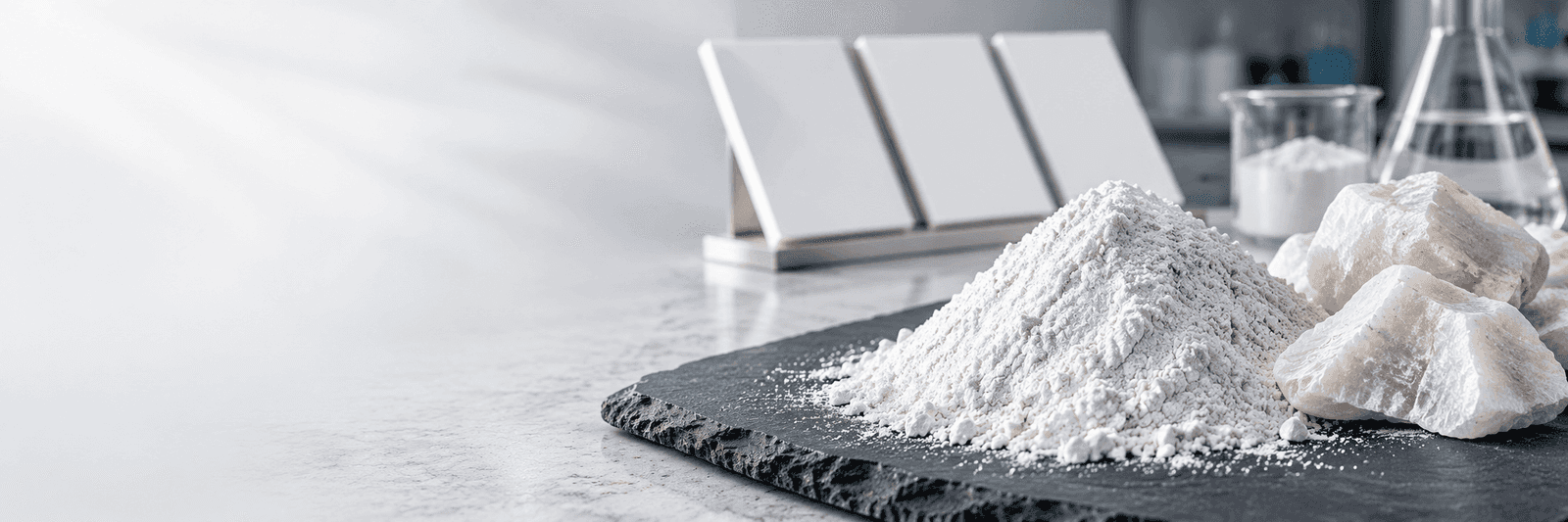
In a paint or plastic formulation, a filler is judged by what it does to the finished product: the brightness of the surface, the way the material flows, the density it adds. Barite is a high-density, chemically inert mineral that has been used as a filler for a long time, and formulators come back to it for the same reasons each time. What changes from supplier to supplier is consistency.
This page is for buyers who are ready to source barite powder in Italy: formulators, procurement managers, technical teams and traders who supply them. It explains what each industry should check, how to test a sample before ordering, what to know about EU import paperwork and how to compare quotes. Namakwala is a third-generation Indian mineral and salt exporter, and barite sits alongside garnet and quartz in its minerals range.
Namakwala Barite is made primarily of barium sulphate (BaSO₄). It has a high specific gravity, low solubility and good resistance to chemical reaction, and it holds up under heat and pressure. Its applications include paints and coatings, rubber and plastics, paper, radiation shielding, glass and chemicals, and oil and gas drilling fluids.
Here is what a buyer in each industry typically cares about:
Industry = What the buyer watches = What to ask the supplier
Paints and coatings = Whiteness and brightness, fine particle size, finish quality = Whiteness value, particle size distribution
Rubber and plastics = Density, consistency, how it disperses = Specific gravity, particle size, moisture
Paper = Brightness, finish = Whiteness, fine particle size
Radiation shielding = Density, consistent bulk behaviour = Specific gravity, bulk density
Glass and chemical = Chemistry and consistency = Chemical analysis, lot certificate
If your end use isn’t on the list, tell us and we’ll discuss it.
Property = What it means for you
Specific gravity: 4.1 to 4.6 g/cm³ = How dense the material is, and how much weight it adds
Bulk density: 2.0 to 2.5 g/cm³ = Affects storage, packing and shipping volume
Mohs hardness: 3.0 to 3.5 = A soft mineral, which is gentler on mixing equipment than a harder filler
Solubility: insoluble in water = Stays stable in water-based systems
Appearance: white or off-white powder = Matters most where the surface is visible
Particle size: customizable = The main lever for finish, flow and dispersion
Particle size and whiteness are the two numbers most worth discussing before you order, because they decide how the powder behaves in your formulation.
Tell us your own limits for each, and we’ll tell you honestly whether a grade fits.
A price per tonne means little until you know what it covers. Compare:
Property = Specification
Chemical Formula = BaSO₄
Specific Gravity = 4.1 – 4.6 g/cm³
Bulk Density = 2.0 – 2.5 g/cm³
Mohs Hardness = 3.0 – 3.5
Solubility = Insoluble in water
Appearance = White / off-white powder
Particle Size = Customizable (powder and lumps)
Note: Specifications can be customized as per industry requirements. Final grade and particle size are confirmed per order.
Namakwala ships from India under export documentation, and packaging is discussed per order. Please confirm current Italian and EU import requirements with your customs broker before shipping.
Buying barite powder well is mostly about two numbers, whiteness and particle size, plus consistency from lot to lot. Ask the five questions, test a sample on your own formulation and compare offers on delivered cost.
Sourcing barite powder for an Italian paint, coatings, plastics or rubber operation? Send us your application, limits, volume and delivery port, and Namakwala will reply with a specification, sample options and a quote.
What is the specific gravity of Namakwala barite?
4.1 to 4.6 g/cm³, with a bulk density of 2.0 to 2.5 g/cm³.
Can the particle size be customized?
Yes. Barite is available as powder and lumps, and particle size can be customized to your requirement.
What appearance does the powder have?
White or off-white.
Which industries use barite?
Paints and coatings, rubber and plastics, paper, radiation shielding, glass, chemicals and oil and gas drilling fluids.
Do I need to check REACH for an import into Italy?
How EU chemical regulation applies depends on classification and volumes. Confirm your obligations with your compliance adviser and customs broker before ordering.