Loading your experience...
Loading your experience...

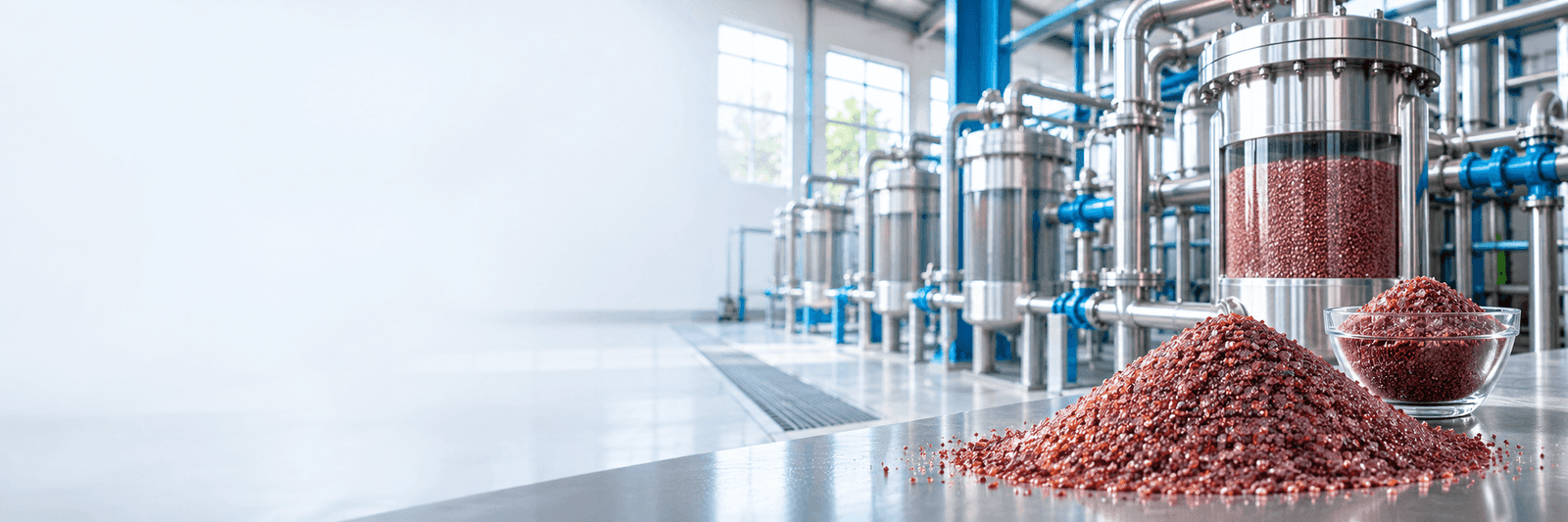
When most people think of garnet, they think of blasting or waterjet cutting. A quieter use is inside water filters, where a layer of garnet does a job that sand alone can’t. It’s a small part of the filter bed, but when it’s specified well, it helps the whole filter work as designed.
This page is for buyers who are ready to source: water-treatment contractors, filter system builders, industrial and pool filtration companies, and distributors who supply them in Italy. It explains how garnet is used in a filter, how to estimate how much you need, what to check on a specification and how to order. Namakwala is a third-generation Indian mineral and salt exporter, and its garnet abrasive is listed for filtration media among its applications.
A multimedia filter uses layers of different materials, so that water passes through coarser, lighter media first and finer, denser media last. Garnet is commonly used as the bottom layer, beneath sand and anthracite, for two reasons:
High density: Namakwala garnet has a specific gravity of 4.0 to 4.2 g/cm³, much higher than sand. After a backwash, the layers settle back into order, with the densest media at the bottom.
Hardness: garnet has a Mohs hardness of 7.5 to 8, so it resists wearing down through repeated backwashing.
The exact layer design, grain sizes and depths come from your filter designer or the equipment maker. This page can’t replace that design, and we’d recommend sharing it with us before we suggest a grade.
Buyer = What they usually need
Water-treatment contractors = Media that matches the design, delivered when the filters are ready
Filter system builders and OEMs = Consistent grain size and repeat supply
Industrial and pool filtration companies = Media to refill or replace on service visits
Distributors = A dependable source and several grades
What to check Why it matters = Namakwala data
Specific gravity = Decides where the media settles after backwash = 4.0 – 4.2 g/cm³
Bulk density = Needed to convert layer volume into weight = 2.3 – 2.5 g/cm³
Hardness = Resistance to wear from backwashing = Mohs 7.5 – 8
Grain size and distribution = Controls how the layer filters and settles = Mesh 12/24, 20/40, 30/60, 80, 120, 200 (customizable)
Chloride and conductivity = Indicate a cleaner material with fewer soluble salts = Chloride below 25 ppm; conductivity below 25 µS/cm
Grain consistency = Affects how evenly the layer behaves = Described as consistent grain size
Two more items matter for filtration, but aren’t on our published sheet: acid solubility and fines content. If your filter specification sets limits for either (many do), tell us, and we’ll discuss test data per lot. Many filtration specifications reference standards such as AWWA B100, but ask any supplier, including us, for the test report for the lot you’re buying instead of relying on a claim.
How to Estimate How Much Garnet You Need
The calculation is simple:
Garnet weight (tonnes) = filter area (m²) × layer depth (m) × bulk density (t/m³)
Namakwala garnet bulk density is 2.3 to 2.5 g/cm³, which equals 2.3 to 2.5 t/m³.
An illustrative project with four filters of 5 m² each and a garnet layer of 0.10 m:
Calculation = Result
Volume per filter = 5 × 0.10 = 0.5 m³
Weight per filter = 0.5 × 2.3 to 2.5 = about 1.15 to 1.25 t
Weight for 4 filters = 1.15 to 1.25 × 4 = about 4.6 to 5.0 t
These figures are illustrative only. Use your own filter areas and the layer depth from your designer, and add an allowance for losses and settling.
If the filter will treat water for human consumption, materials in contact with the water may need to meet specific requirements under EU and Italian rules. Please confirm what applies with your compliance adviser or the relevant authority before specifying any media, and tell us the end use so we can discuss which documents and test data you can request. We haven’t claimed any drinking-water approval on this page.
Namakwala garnet is described as free from hazardous crystalline silica. Fine dust of any mineral should still be controlled, so use ventilation and appropriate protection when loading filters, and ask us for safety documentation when you enquire.
Property = Specification
Source = Almandine garnet
Mohs Hardness = 7.5 – 8
Specific Gravity = 4.0 – 4.2 g/cm³
Bulk Density = 2.3 – 2.5 g/cm³
Chloride Content = Less than 25 ppm
Conductivity = Less than 25 µS/cm
Mesh Sizes Available = 12/24, 20/40, 30/60, 80, 120, 200 (customizable)
Note: Specifications can be customized as per industry needs. Final grade is confirmed per order.
Namakwala ships from India under export documentation, and packaging is discussed per order. Natural garnet is typically classified under HS 2513, but confirm the code, duties and any EU requirements with your customs broker before shipping.
Garnet earns its place in a filter by being dense, hard and consistent. Get the layer design from your designer, size the quantity with the formula above, check the spec and test data, and compare quotes on delivered cost.
Sourcing garnet filter media for an Italian project? Send us your application, media specification, quantity and delivery port, and Namakwala will reply with a specification, sample options and a quote.
Why is garnet used in multimedia filters?
It’s dense and hard, so it settles as the bottom layer after backwashing and resists wear. Your filter designer sets the exact layers and grain sizes.
What are the specifications of Namakwala garnet?
Mohs hardness 7.5 to 8, specific gravity 4.0 to 4.2, bulk density 2.3 to 2.5, chloride below 25 ppm and conductivity below 25 µS/cm.
Which mesh sizes are available?
12/24, 20/40, 30/60, 80, 120 and 200, and sizes can be customized.
Is the garnet suitable for drinking water?
We haven’t claimed any drinking-water approval. Tell us the end use, and confirm requirements with your compliance adviser. We can discuss available test data.
Can I get a sample before ordering?
Please contact Namakwala with your requirement, and the team will discuss sample options.