Loading your experience...
Loading your experience...

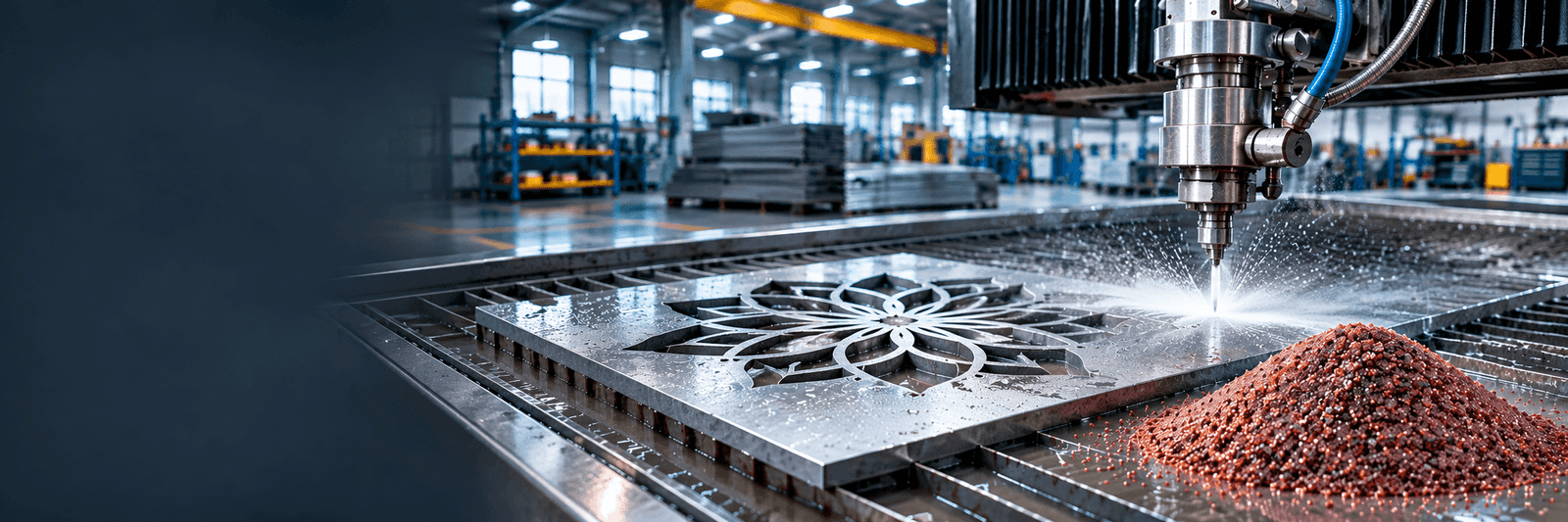
Most Italian waterjet shops already have a garnet supplier, usually a local distributor with stock on the shelf. That’s convenient, and for urgent top-ups it’s hard to beat. The real question for a shop buying garnet every week is whether a second source, imported directly, would lower the cost of each cutting hour without adding risk.
This page is for buyers who are ready to compare: waterjet operators, metal and general fabricators, machine service companies and consumables distributors in Italy. It gives you a scorecard for judging any garnet supplier, a worked example of cost per cutting hour, a hybrid sourcing plan and a low-risk way to test a new source. Namakwala is a third-generation Indian mineral and salt exporter, and garnet abrasive is one of its core minerals.
Namakwala garnet is derived from almandine garnet:
Property = Specification
Mohs hardness = 7.5 – 8
Specific gravity = 4.0 – 4.2 g/cm³
Bulk density = 2.3 – 2.5 g/cm³
Chloride content = Less than 25 ppm
Conductivity = Less than 25 µS/cm
Mesh sizes = 12/24, 20/40, 30/60, 80, 120, 200 (customizable)
It is described as free from hazardous crystalline silica, and supplied with consistent grain size. For waterjet work, buyers usually ask about 80, 120 and 200 mesh. Always confirm the mesh your machine manufacturer recommends, since nozzle and orifice settings affect the best choice.
Price per tonne is the easiest number to compare and the least useful on its own. A scorecard makes you weigh everything that affects your cutting hours. Score each supplier from 1 (poor) to 5 (excellent) and multiply by the weight. The weights below are a starting point, so change them to suit your shop.
Criterion = Weight = What to look at
Grade consistency = 25% = Mesh and grain size from lot to lot; lot data supplied
Delivered cost = 25% = Price plus freight, port, clearing and transport (see the cost example below)
Cutting performance = 20% = Result of your own trial: speed, edge, feed behaviour
Reliability of supply = 15% = Lead time and how well it has been kept
Documents and data = 10% = Specification, lot data, safety data sheet, shipping documents
Support and communication = 5% = How fast and clearly the supplier answers
Total = sum of (score × weight). A supplier that scores high on price but low on consistency may lose to one that scores slightly lower on price but high on everything else. Fill in the scorecard for your current supplier too, so you’re comparing like with like.
The number that matters is the garnet-related cost of one hour of cutting, including what a poor lot costs you in lost time. The formula is:
Garnet cost per cutting hour = (abrasive flow in kg/h × price per kg delivered) + (cutting time lost to garnet problems × machine cost per hour)
An illustrative comparison, using cost units, not real prices and not Namakwala prices:
Offer A (lower price) = Offer B (higher price, more consistent)
Abrasive flow = 24 kg/h = 24 kg/h
Delivered price per kg = 1.00 = 1.10
Garnet cost per hour = 24.0 = 26.4
Cutting time lost to feed or consistency problems = 5% of the hour = 0%
Machine cost per hour = 120 = 120
Cost of lost time = 6.0 = 0
Total per cutting hour = 30.0 = 26.4
All numbers are illustrative. Use your own flow rate, delivered prices and machine hour cost, and measure lost time during a real trial.
The point isn’t that the more expensive offer always wins. It’s that a small price gap can be wiped out by a small amount of lost cutting time, so measure it before you decide.
You don’t have to choose between a local distributor and a direct import. Many shops use both:
Role = Source = Why
Regular volume = Direct import, planned in container or pallet loads = Lower delivered cost on predictable demand
Urgent top-ups = Local distributor = Fast delivery when stock runs low
Safety stock = Your own store = Covers shipping time and delays
For the direct-import volume, work out a reorder point: average use per week × (shipping lead time in weeks + buffer in weeks). Ask us for current lead times, and set your own buffer.
Don’t switch your whole supply on a datasheet. A pilot plan limits your risk:
We can give you the specification and discuss test data for each lot. We can’t promise your machine will behave in a particular way, because that depends on your settings, water and nozzle condition. That’s why the trial matters.
Buyer = What they usually need
Metal and general fabricators = Consistent 80 mesh, shipment after shipment
Machine service companies = Abrasive to supply with service contracts
Waterjet job shops = A second source to reduce dependence on one distributor
Distributors = A direct source and several grades
Property = Specification
Source = Almandine garnet
Mohs Hardness = 7.5 – 8
Specific Gravity = 4.0 – 4.2 g/cm³
Bulk Density = 2.3 – 2.5 g/cm³
Chloride Content = Less than 25 ppm
Conductivity = Less than 25 µS/cm
Mesh Sizes Available = 12/24, 20/40, 30/60, 80, 120, 200 (customizable)
Note: Specifications can be customized as per industry needs. Final grade is confirmed per order and supported by documentation.
Namakwala ships from India under export documentation, and packaging is discussed per order. Please confirm current Italian and EU import requirements with your customs broker before shipping.
A second garnet source is worth it only if it lowers the cost of a cutting hour without adding risk. Score suppliers on more than price, cost the cut, use a hybrid plan so local stock covers urgent needs and prove the new source with a pilot before you move volume.
Considering a direct-import waterjet garnet source for an Italian shop? Send us your mesh size, monthly volume, delivery port and price basis, and Namakwala will reply with a specification, sample options and a quote.
Which mesh size is used for waterjet cutting?
80 mesh is the common general-purpose grade. 120 and 200 mesh are used for finer work. Follow your machine manufacturer’s recommendation.
Should I replace my local distributor with a direct import?
Not necessarily. Many shops use direct import for regular volume and a local distributor for urgent top-ups.
How do I compare two garnet offers fairly?
Use a weighted scorecard and calculate cost per cutting hour, including time lost to feed or consistency problems, not just price per tonne.
Is the garnet free from crystalline silica?
Namakwala garnet is described as free from hazardous crystalline silica.
Can I get a sample before ordering?
Please contact Namakwala with your requirement, and the team will discuss sample options.