Loading your experience...
Loading your experience...

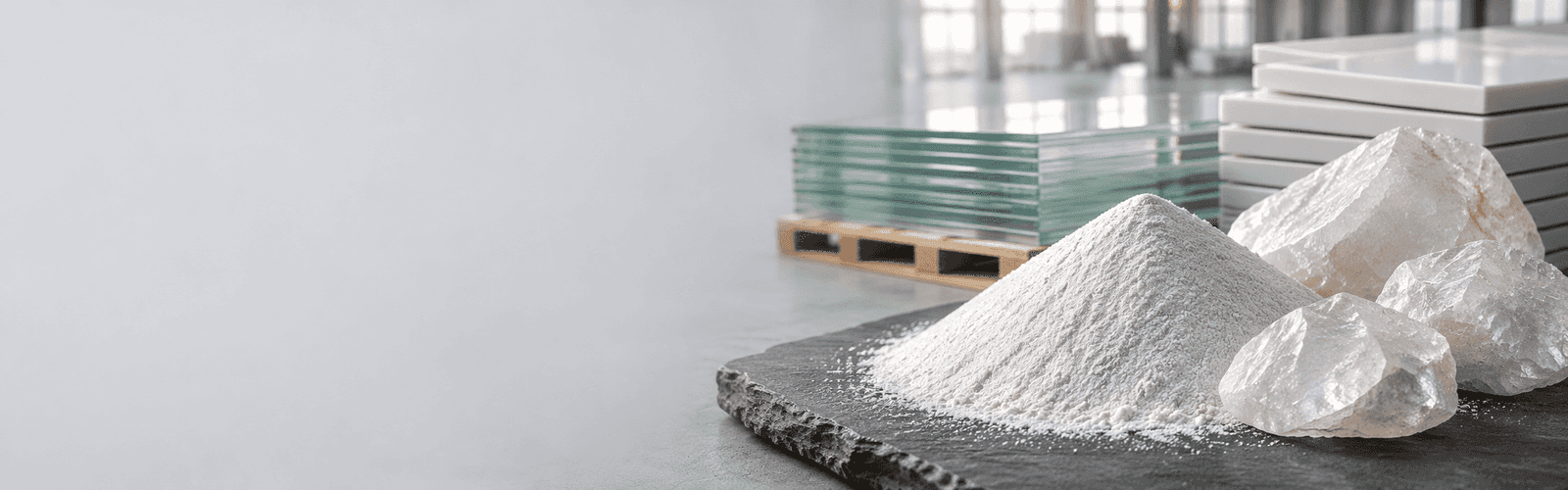
Nigeria has a lot of silica sand, and for many uses, local sand does the job well. So a fair question for any glass, ceramics or paint maker is: why import quartz at all?
The honest answer is that sometimes you shouldn’t, and sometimes you should. This page helps you tell the difference. It’s written for buyers who are ready to source: glass and ceramics manufacturers, paint and coatings makers, foundries and the traders who supply them. It explains when imported high-purity quartz earns its cost, how a small amount of iron can matter, how to compare delivered cost and how to order. Namakwala is a third-generation Indian mineral and salt exporter, and quartz sits alongside garnet and barite in its minerals range.
Your situation = Local sand may be fine = Imported high-purity quartz is worth testing
Colour of the finished product = Coloured or dark glass, tinted bodies = Clear glass, white tiles, light-coloured products
Purity limits = Loose chemistry tolerance = Tight limits on iron, alumina or SiO₂
Particle size = A coarse or mixed size is acceptable = A defined, consistent powder grade
Consistency = Variation between loads is manageable = Variation forces you to retune the recipe
Application = Fill, general foundry sand = Fine powder for glazes, bodies, coatings and fillers
If you’re in the left column, local sand may well be the right buy. If you’re in the right column, test a sample before you decide.
Iron oxide (Fe₂O₃) is the impurity that tints glass and darkens a ceramic body. The amounts are small, which is why it’s easy to underestimate.
A worked example
An illustrative glass batch of 1,000 kg, where the silica source makes up 600 kg:
Silica source = Fe₂O₃ in the silica = Iron oxide added to the batch
Sand at 0.10% Fe₂O₃ = 0.10% × 600 kg = 0.60 kg
Quartz below 0.03% Fe₂O₃ = below 0.03% × 600 kg = below 0.18 kg
These figures are illustrative only. Your batch composition and colour tolerance will differ.
The difference is a few hundred grams per tonne of batch, but in clear glass that can be the difference between a clean, colourless product and a green tint. Namakwala quartz has Fe₂O₃ below 0.03%, and low-iron grades are available.
Property = Namakwala quartz = What it affects
SiO₂ = 99% – 99.9% = Overall purity
Fe₂O₃ = Below 0.03% (low-iron grades available) = Colour of glass and ceramics
Al₂O₃ = Below 0.5% = Melting and firing behaviour
Whiteness = 85% – 98% = Look of tiles, sanitaryware, paints and fillers
Mesh sizes = 50, 100, 200, 300, 500 (customizable) = Melting, packing and finish
Mohs hardness = 7 = Wear and abrasion
Forms = Lumps, grains, powder = Whether you grind in-house
The approximate particle sizes for the mesh range are 300 microns (50 mesh), 150 microns (100), 75 microns (200), 50 microns (300) and 25 microns (500).
This is a starting point only. Your technical team’s own recipe and limits come first.
Application = What the buyer watches = Typical starting point
Clear and light glass = Iron, overall chemistry, consistency = Low-iron, high-purity grade, in grain or fine powder
Ceramic tiles and sanitaryware = Whiteness, iron, fineness = Higher whiteness, low iron, finer mesh
Paints, coatings and fillers = Whiteness, fine particle size = Fine mesh, high whiteness
Foundry and ferro-alloys = Purity, lump or grain form = High SiO₂, lump or grain supply
Don’t compare a local price per tonne with an imported price per tonne. Compare what you pay for each tonne you actually use:
Cost per usable tonne = (price + freight + port and clearing + inland transport) ÷ yield
Here, yield is the share of material that ends up in your product. Include these in the comparison:
For some buyers, imported quartz costs more per tonne but less per usable tonne. For others, local sand wins. The calculation tells you which.
Quartz is crystalline silica, and fine dust must not be inhaled. Use dust control, ventilation and suitable respiratory protection, and follow your site’s safety rules. Ask us for safety documentation when you enquire.
Quartz Specifications
Property = Specification
SiO₂ (Silica) = 99% – 99.9%
Fe₂O₃ (Iron Oxide) = Below 0.03% (low-iron grades available)
Al₂O₃ = Below 0.5%
Whiteness = 85% – 98%
Mohs Hardness 7
Mesh Sizes = 50, 100, 200, 300, 500 (customizable)
Forms = Lumps, grains, powder
Note: Specifications can be customized as per industry needs. Final grade is confirmed per order.
Namakwala ships from India under export documentation, and packaging is discussed per order. Natural quartz is typically classified under HS 2506, but confirm the code, duties and any Nigerian import requirements with your clearing agent before shipping.
Imported quartz isn’t always the right buy in a country with plenty of local sand, but when colour, purity or consistency matter, it can be. Check where you sit in the table, work out the iron effect, compare delivered cost per usable tonne and test a sample before you commit.
Considering high-purity quartz for a Nigerian glass, ceramics, paint or foundry operation? Send us your application, limits, volume and delivery port, and Namakwala will reply with a grade recommendation and quote.
Why import quartz when Nigeria has silica sand?
Local sand is often fine for coloured products and loose specifications. Imported high-purity quartz is worth testing where iron, purity, whiteness or consistency matter.
What is the iron content of Namakwala quartz?
Fe₂O₃ below 0.03%, with low-iron grades available.
What mesh sizes are available?
50, 100, 200, 300 and 500 mesh, and sizes can be customized.
Does Namakwala supply lumps and grains as well as powder?
Yes. Quartz is supplied as lumps, grains and powder.
Can I get a sample before ordering?
Please contact Namakwala with your requirement, and the team will discuss sample options.