Loading your experience...
Loading your experience...

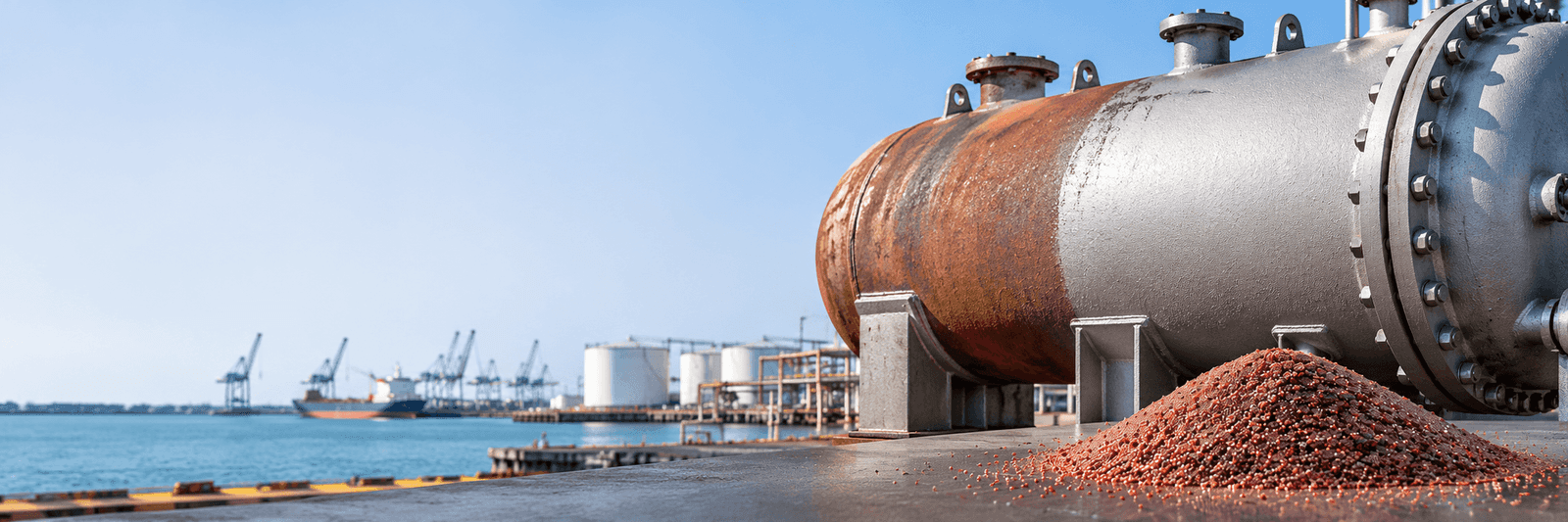
Blasting demand in the Eastern Province doesn’t arrive evenly. It comes in waves: a plant shuts down for maintenance, dozens of crews arrive, and for a few weeks the site consumes abrasive at a rate nobody sees the rest of the year. Contractors who planned their abrasive in advance finish on schedule. Those who didn’t spend the shutdown chasing stock.
This page is for buyers who are ready to source: blasting contractors, fabrication yards, shutdown and maintenance planners, and distributors serving Dammam, Jubail and the wider Eastern Province. It’s organised around the problem that matters most there: sizing a shutdown order, timing it and getting it from the port to the plant. Namakwala is a third-generation Indian mineral and salt exporter, and garnet abrasive is one of its core minerals.
Namakwala garnet is derived from almandine garnet:
Property = Specification
Mohs hardness = 7.5 – 8
Specific gravity = 4.0 – 4.2 g/cm³
Bulk density = 2.3 – 2.5 g/cm³
Chloride content = Less than 25 ppm
Conductivity = Less than 25 µS/cm
Mesh sizes = 12/24, 20/40, 30/60, 80, 120, 200 (customizable)
It is described as free from hazardous crystalline silica, and its listed applications include oil and gas and shipbuilding. For blasting, the grades buyers ask about are 12/24, 20/40 and 30/60, and the right one comes from your coating specification and required surface profile. The low chloride and conductivity figures matter on the coast, where soluble salts on steel can cause coating problems. Ask any supplier, including us, for the test report for the lot you’re buying.
Buyer = What they usually need
Blasting contractors = A grade that suits the coating spec, enough stock for the whole shutdown
Fabrication and coating yards = Steady supply for shop blasting before painting or galvanizing
Maintenance and shutdown planners = Abrasive confirmed and on site before crews mobilise
Distributors = A direct source for regular volume and several grades
The quantity depends on how much steel you’ll blast and how much abrasive each square metre takes. The formula is:
Garnet (t) = surface area (m²) × consumption rate (kg/m²) ÷ 1,000 × (1 + buffer)
Your consumption rate comes from your own trial, since it depends on the grade, the starting condition of the steel, your equipment and whether you recycle. An illustrative shutdown, using an assumed rate:
Step = Calculation = Result
Surface area to blast = 8,000 m²
Assumed consumption rate = 30 kg/m²
Garnet before buffer = 8,000 × 30 ÷ 1,000 = 240 t
With a 10% buffer = 240 × 1.10 = 264 t
These figures are illustrative only and are not Namakwala data. Measure your real consumption rate on a trial area before you size an order.
Shutdown dates don’t move, so the order has to be placed early enough to arrive in time. The formula is:
Order-by date = date needed on site − (transit + port clearance + inland haulage + safety buffer)
An illustrative example, with assumed durations:
Step = Assumed time
Sea transit = 6 weeks
Port clearance = 1 week
Inland haulage to site = 1 week
Safety buffer = 2 weeks
Total = 10 weeks
If the abrasive is needed on site on 1 June, the order-by date in this example is about 23 March. The durations above are assumptions for illustration. Ask us for current lead times, and confirm clearance and haulage times with your clearing agent.
Many buyers keep local stock for urgent top-ups and buy the planned shutdown volume directly. That way a late delivery doesn’t stop the crews.
Humidity near the coast and fine dust blowing in from the desert both affect abrasive. Keep bags off the floor, on pallets, in a dry, covered space. Re-seal opened bags, cover stockpiles and use older stock first. Damp abrasive blocks blasting equipment and cleans poorly.
Comparing Quotes
Namakwala is also an ADNOC-approved vendor. That reflects its ability to meet compliance and supply-chain standards, but it isn’t a supply contract with any company, and we haven’t named any customer on this page.
Property = Specification
Source = Almandine garnet
Mohs Hardness = 7.5 – 8
Specific Gravity = 4.0 – 4.2 g/cm³
Bulk Density = 2.3 – 2.5 g/cm³
Chloride Content = Less than 25 ppm
Conductivity = Less than 25 µS/cm
Mesh Sizes Available = 12/24, 20/40, 30/60, 80, 120, 200 (customizable)
Note: Specifications can be customized as per industry needs. Final grade is confirmed per order and supported by documentation.
Shutdown blasting rewards planning. Size the order from a measured consumption rate, work back from the date you need it on site, prepare the port-to-plant chain in advance and compare quotes on delivered cost and consistency.
Planning a blasting job in Dammam, Jubail or the Eastern Province? Send us your grade, quantity, date needed on site and delivery port, and Namakwala will reply with a specification, current lead times and a quote.
Which garnet mesh size is used for blasting?
12/24, 20/40 and 30/60 are the blasting grades. The right one depends on your coating specification and required surface profile.
How do I estimate how much garnet a shutdown needs?
Multiply the surface area by your measured consumption rate in kg per square metre, then add a buffer. Measure the rate on a trial area first.
When should I place the order?
Work back from the date you need it on site, allowing for transit, port clearance, inland haulage and a safety buffer. Ask Namakwala for current lead times.
Why do chloride and conductivity matter?
Soluble salts left on steel can cause coating blistering, particularly near the coast. Namakwala garnet is specified at chloride below 25 ppm and conductivity below 25 µS/cm. Ask for the test report for your lot.
Can I get a sample before ordering?
Please contact Namakwala with your requirement, and the team will discuss sample options.