Loading your experience...
Loading your experience...

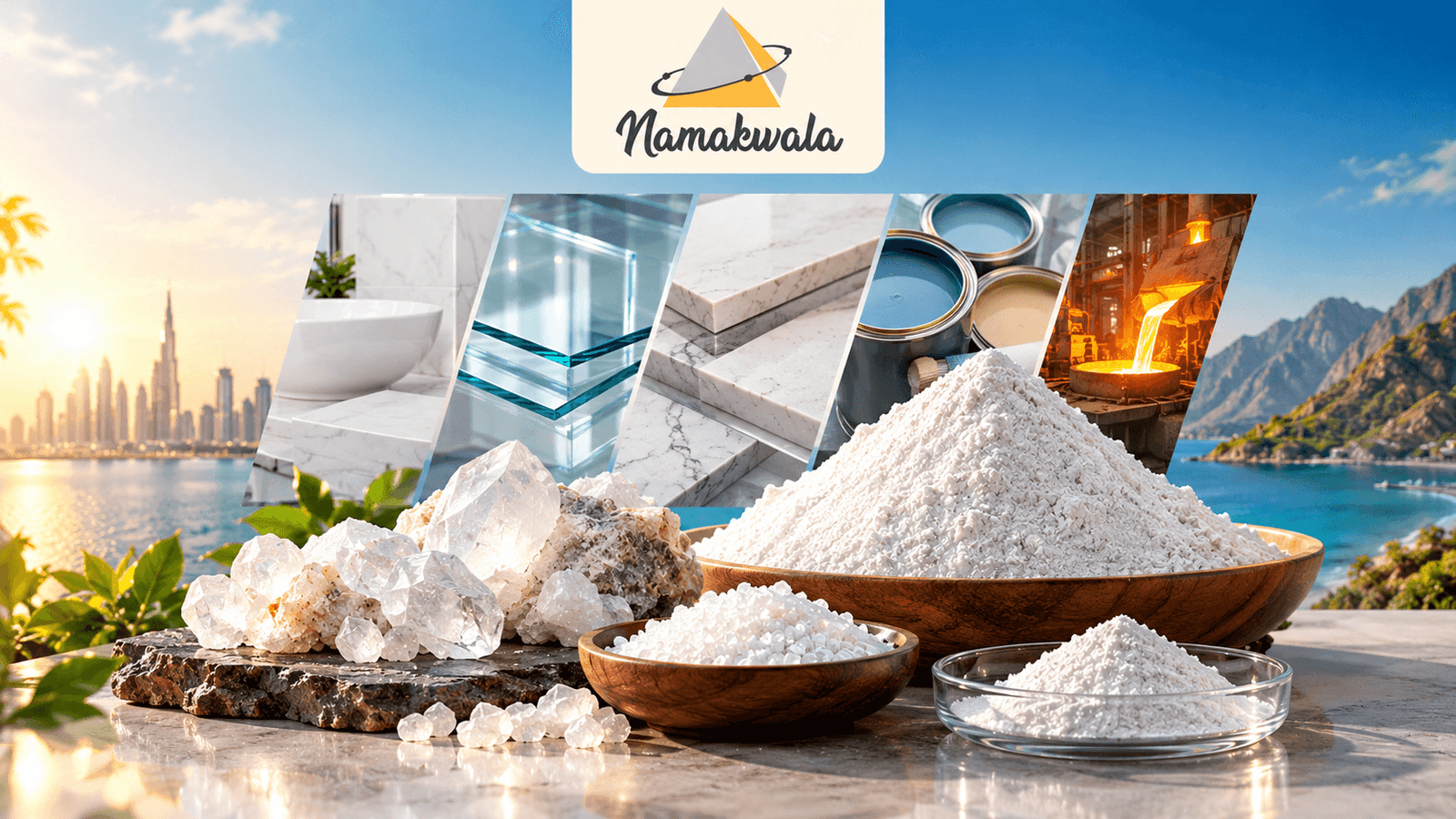
Two quartz powders can look identical in a bag and behave very differently in a kiln or a glass furnace. One has a trace more iron, another is milled a little coarser, and a batch of tiles comes out a shade darker or a glass melt takes on a tint. For UAE manufacturers, the quartz powder decision is mostly about four numbers: purity, iron, whiteness and mesh size.
This guide explains each of the four, then matches them to the main uses in the UAE: ceramics, glass, engineered stone and construction products. Namakwala is an Indian mineral and salt exporter, and quartz is part of its minerals range alongside garnet and barite.
This is the headline purity figure. Namakwala quartz is available from 99% to 99.9% SiO₂. Higher purity costs more, so buy the grade your application actually needs and don’t pay for purity you won’t use.
Iron is the impurity that causes the most trouble, because it colours the product. Namakwala quartz has Fe₂O₃ below 0.03%, and low-iron grades are available. If you make clear glass or light-coloured tile, iron is the number to check first.
Namakwala quartz whiteness runs from 85% to 98%. Whiteness matters most where the finished surface is seen: tiles, sanitaryware, engineered stone and paints.
Namakwala quartz powder is available in 50, 100, 200, 300 and 500 mesh, and sizes can be customized. Finer powder means a smaller particle, which affects how it melts, packs and finishes. The approximate particle sizes are:
Mesh = Approximate particle size
50 = about 300 microns
100 = about 150 microns
200 = about 75 microns
300 = about 50 microns
500 = about 25 microns
This table is a starting point. Your own technical team will know the exact requirement, so send us your process and we’ll match the grade.
Application = What matters most = Typical starting point
Ceramic tiles and sanitaryware = Whiteness, iron, consistent fineness = Higher whiteness, low-iron grade, finer mesh
Glass = Low iron, consistent chemistry = Low-iron, high-purity grade
Engineered stone and construction products = Whiteness, particle size mix = Grades and sizes to suit the formulation
Paints, coatings and fillers = Whiteness, fine particle size = Fine mesh, high whiteness
Foundry and ferro-alloys = Purity, lump or grain form = High SiO₂, lump or grain supply
Ceramics and glass manufacturing are established industries in the UAE, with Ras Al Khaimah well known for ceramics. For these plants, consistent supply matters as much as the first sample, because a change in quartz between lots can force the production team to retune a recipe.
Namakwala supplies quartz as lumps, grains and powder. A glass or ferro-alloy plant may buy lumps or grains, while a ceramics or filler buyer will usually want powder. If you currently buy grains and grind them in-house, ask us about the powder as well, since it may save you a step.
Quartz is crystalline silica. Fine dust from quartz powder should not be inhaled, so use dust control, ventilation and suitable respiratory protection, and follow the workplace safety rules that apply to your site. Ask us for safety documentation when you enquire.
Before a bulk order, test a sample against your own requirements:
Property = Specification
SiO₂ (Silica) = 99% – 99.9%
Fe₂O₃ (Iron Oxide) = Below 0.03% (low-iron grades available)
Al₂O₃ = Below 0.5%
Whiteness = 85% – 98%
Mohs Hardness = 7
Mesh Sizes = 50, 100, 200, 300, 500 (customizable)
Forms = Lumps, grains, powder
Note: Specifications can be customized as per industry needs. Final grade is confirmed per order.
Namakwala ships from India under export documentation. Please confirm current UAE import and customs requirements with your clearing agent before shipping.
Choosing quartz powder comes down to four numbers and one honest question: what does your process actually need? Match purity, iron, whiteness and mesh to the job, test a sample, and you’ll avoid most of the problems that come from switching lots.
Buying quartz powder for a UAE ceramics, glass or construction operation? Send us your specification, volume and delivery port, and Namakwala will confirm the grade and quote.
What purity is Namakwala quartz?
99% to 99.9% SiO₂, with Fe₂O₃ below 0.03% and low-iron grades available.
What mesh sizes are available for quartz powder?
50, 100, 200, 300 and 500 mesh, and sizes can be customized.
Which quartz grade is best for glass?
Glass makers generally need a low-iron, high-purity grade, because iron tints the glass. Share your specification and we’ll match it.
Does Namakwala supply lumps and grains as well as powder?
Yes. Quartz is supplied as lumps, grains and powder.
Is quartz dust hazardous?
Fine quartz dust contains crystalline silica and should not be inhaled. Use dust control and respiratory protection, and ask us for safety documentation.